Why Is My Swimming Pool Green? Causes & Solutions in Malaysia
Swimming pool turning green? Learn what causes green pool water in Malaysia, how to fix it with chlorine and filtration, and prevent algae from returning.
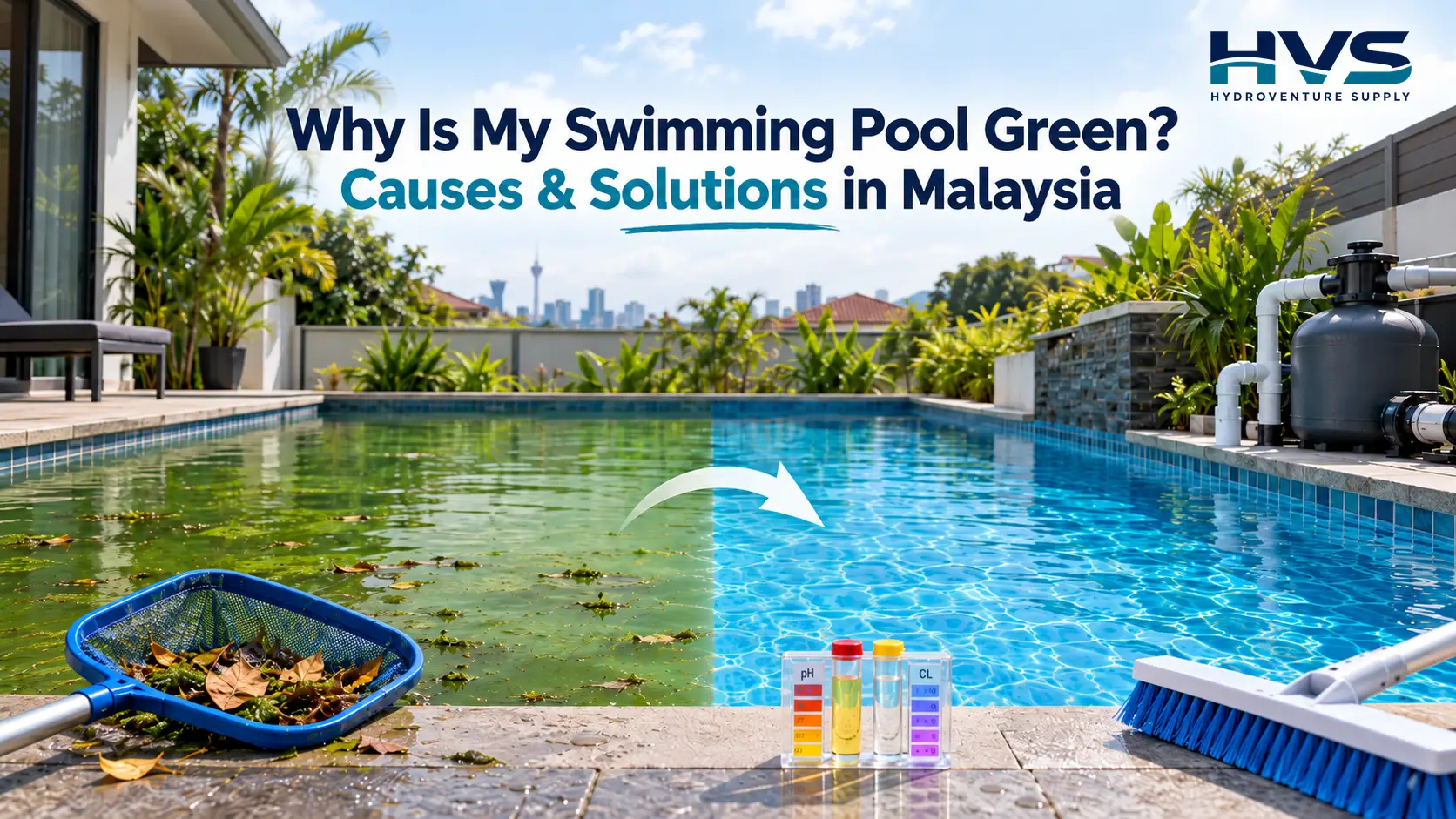
Why Is My Swimming Pool Green? Causes & Solutions in Malaysia
A green swimming pool is usually caused by algae growing when chlorine levels are too low, water circulation is poor, or the pool's water balance is not properly maintained. In Malaysia, hot weather, strong sunlight and frequent heavy rain can make the problem appear surprisingly quickly.
The good news? Most green pools can be treated without completely draining the water.
The important thing is to find out why your pool turned green before adding more chemicals.
Why Does Swimming Pool Water Turn Green?
Imagine your swimming pool looked perfectly fine a few days ago. Then, after a weekend of heavy rain, the water suddenly looks cloudy and green.
This is often a sign of algae growth.
Algae are tiny organisms that grow in water. When your pool does not have enough effective chlorine to control them, they can multiply and turn the water green.
Here are the most common reasons this happens.
1. Not Enough Chlorine
Chlorine helps keep your swimming pool clean by controlling algae and harmful germs.
However, chlorine is gradually used up by sunlight, dirt, sweat, leaves and other contaminants.
When the chlorine level becomes too low, algae can start growing.
This is one of the first things to check when your swimming pool turns green.
2. Heavy Rain and Hot Weather
Malaysia's tropical weather can make pool maintenance more challenging.
Heavy rain can introduce dirt and debris, dilute pool chemicals and affect water balance. Meanwhile, strong sunlight can break down chlorine faster in outdoor pools.
This is why your pool might turn green after several days of rain, especially if the chlorine level was already low.
Tip: After a heavy downpour, check your pool water instead of assuming the chlorine level is still normal.
3. Poor Water Circulation or Filtration
Your pool pump and filter work together to circulate water and remove dirt.
If the pump is not running properly, the filter is clogged, or certain areas of the pool receive very little circulation, algae may grow more easily.
Signs of a possible circulation problem include weak water flow from the return jets, a dirty filter or debris collecting in the same areas.
4. Incorrect pH Levels
pH tells you how acidic or alkaline your pool water is.
If the pH becomes too high, chlorine becomes less effective at killing germs and controlling algae.
An unsuitable pH can also affect water clarity, swimming comfort and pool equipment.
5. Too Much Chlorine Stabilizer
Some chlorine products, such as TCCA, contain stabilizer that helps protect chlorine from sunlight.
This is useful for outdoor swimming pools in Malaysia.
However, using stabilized chlorine repeatedly can cause stabilizer levels to build up over time. Too much stabilizer can slow down chlorine's disinfecting action, making algae more difficult to control.
If your pool keeps turning green even though you regularly add chlorine, consider getting the stabilizer level checked.
Green and Cloudy or Clear but Green? Check This First
Not every green swimming pool has the same problem.
Before treating the water, look at its appearance.
What your pool looks like | Possible cause | What to check |
|---|---|---|
Green, cloudy water with slippery walls | Algae growth | Chlorine, pH and filtration |
Green water after heavy rain | Water imbalance or contamination leading to algae | Chlorine, pH and debris |
Green water with weak circulation | Pump or filter problem | Pump, baskets and filter |
Clear water with a green or blue-green tint | Possible dissolved metals, such as copper | Professional water or metal testing |
Important: Clear but green water is not always algae. If metals are responsible, repeatedly adding shock chlorine may worsen discolouration or staining. Confirm the cause before treatment.
How to Fix a Green Swimming Pool: Step by Step
If your pool is green and cloudy because of algae, the following steps can help restore clean water.
Step 1: Stop Swimming and Remove Debris
Avoid swimming in a green pool until the water is clear, the circulation system is working and water-quality tests confirm it is suitable for use.
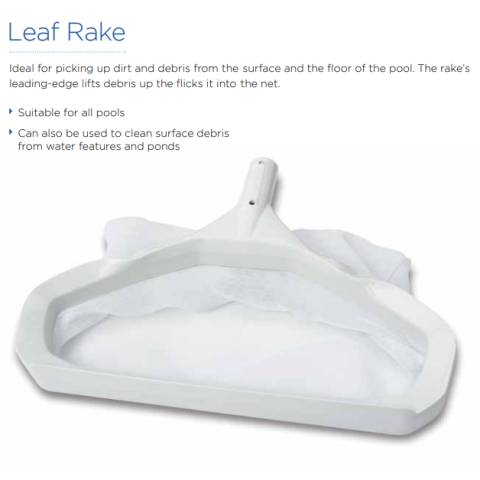
Start by removing leaves, insects and floating debris with a pool net.
This reduces the amount of dirt that your chlorine and filtration system need to handle.
Check the skimmer basket and pump basket for blockages.
You can find suitable nets, vacuum heads and cleaning accessories in our Swimming Pool Cleaning Equipment collection.
Step 2: Test Your Pool Water
Before adding chemicals, test your pool's chlorine and pH.
Testing helps you understand whether the water needs more sanitizer, a pH adjustment, or further investigation.
For reference, Malaysia's Ministry of Health public-pool guidelines list a pH range of 7.0–7.8 and free chlorine of 0.5–3.0 ppm. The appropriate chlorine target may differ depending on the pool and chlorine stabilizer used. For example, the CDC recommends at least 2 ppm free chlorine for pools using cyanuric acid stabilizer.
If your pool frequently turns green, it is also worth checking the stabilizer (cyanuric acid) level. Malaysia's public-pool guideline lists a maximum of 50 ppm.
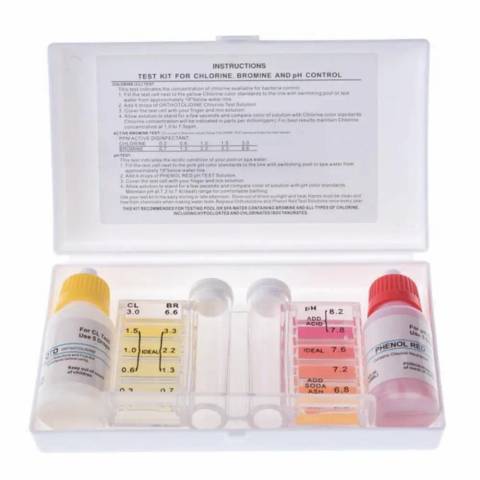
For simple routine monitoring, our HVS 2-in-1 Chlorine and pH Test Kit can help check basic water conditions. For diagnosing an algae problem, use a suitable free-chlorine test, such as a DPD test, because basic OTO chlorine tests measure total chlorine rather than free chlorine separately.
Step 3: Correct the Water Balance
If your test shows the pH is outside the appropriate range, adjust it using a suitable pool treatment chemical.
For example:
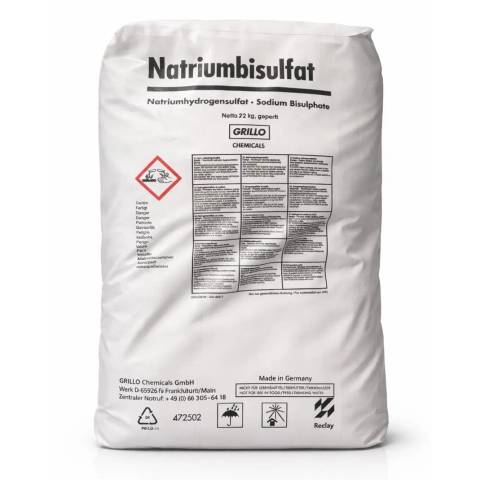
pH too high: A pH reducer, such as HVS Dry Acid (pH Down), may be needed.
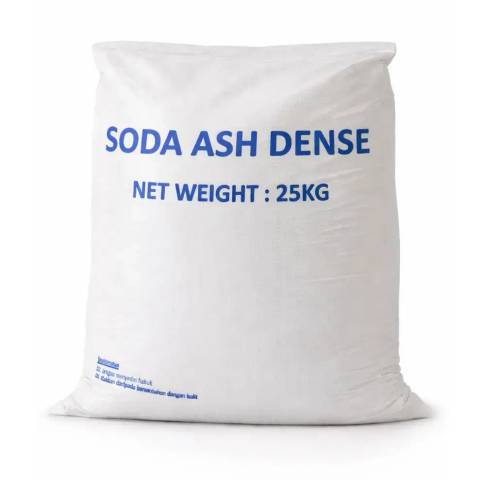
pH too low: A pH increaser, such as soda ash, may be needed.
Only use these chemicals when testing shows they are necessary. The amount required depends on your pool volume, current readings and the product instructions.
Always handle each chemical separately and never mix pool chemicals together.
Step 4: Treat the Algae With the Right Chlorine
Once the cause has been checked and the water balance corrected, an algae-affected pool may need shock chlorination.
Shock treatment means temporarily raising the chlorine concentration to a level suitable for treating algae and heavy contamination.
The correct treatment depends on your pool size, existing chlorine level, stabilizer level and the chlorine product being used.
Common treatment options include calcium hypochlorite and liquid chlorine.
For example, Hydroventure Supply supplies STARCHLON Calcium Hypochlorite 70%, a fast-releasing chlorine product used for pool disinfection and shock treatment.
However, calcium hypochlorite also adds calcium to the water, so it may not suit every pool. If stabilizer is already high, continuously adding stabilized chlorine such as TCCA may make the problem more difficult to solve.
Always follow the correct treatment instructions for your particular product. For severe algae problems or when using concentrated chemicals, consult a qualified pool professional.
Not sure which chlorine is suitable? Read our guide: Calcium Hypochlorite 70% vs TCCA 90% — Which Should You Choose?.
You can also browse our Swimming Pool Chlorine collection.
Step 5: Brush the Pool Walls and Floor
Algae do not only grow in the water. They can also stick to pool walls, steps, corners and the floor.
Brushing helps loosen algae so the chlorine can reach it more effectively.
Pay extra attention to areas where water circulation is weaker.
Use a brush suitable for your pool surface to avoid damaging the finish.
Step 6: Run the Filtration System and Remove the Dead Algae
Even after the chlorine kills the algae, the pool may still look cloudy.
Why? Because dead algae and fine particles remain suspended in the water.
Your filtration system needs to remove them.
During recovery, maintain adequate circulation and follow your pump and filter manufacturer's operating instructions.
If you have a sand filter, backwash it when needed according to the filter-pressure reading and manufacturer's instructions. If you have a cartridge filter, clean the cartridge using the proper method instead.
Vacuum any settled debris from the pool floor.
If the water remains heavily cloudy, a suitable clarifier or flocculant may sometimes help, but these products are not necessary for every green pool. Some flocculants require vacuuming settled material directly to waste and may not be suitable for certain filter systems.
If your filter is struggling or you are considering an upgrade, explore our Swimming Pool Filters.
Step 7: Retest Before Swimming
Once the water has cleared, test the chlorine and pH again.
Do not return to swimming simply because the water looks blue. Make sure the water is clear enough to see the pool bottom, all treatment chemicals have returned to appropriate operating levels, and the pump and filtration system are working correctly.
If the pool is still green, repeat the diagnosis rather than automatically adding more chemicals.
Why Is My Pool Still Green After Adding Chlorine?
Sometimes pool owners add chlorine, but the water stays green.
There are several possible explanations.
The chlorine level is still insufficient. A heavily contaminated pool can consume chlorine quickly, so one treatment may not be enough.
The pH is too high. High pH can reduce chlorine's effectiveness.
There is too much stabilizer. A buildup of cyanuric acid from stabilized chlorine can make disinfection less effective.
The filtration system is not working properly. Chlorine may control the algae, but dead algae still needs to be filtered or vacuumed out.
The green colour is caused by metals. If the water is clear but green or blue-green, get it checked for metals before adding more chlorine.
If repeated treatment is not improving the pool, it is worth getting a more complete water test instead of continuing to add chemicals without knowing the cause.
How Long Does It Take for a Green Pool to Become Clear?
There is no fixed recovery time.
A lightly affected pool may improve within a day or two of appropriate treatment, while a severely green pool may take several days or longer.
The recovery time depends on how much algae is present, how effectively the water is treated, and whether the pump and filter can remove the remaining particles.
Remember: killing the algae and clearing the water are two different parts of the job.
How to Prevent Your Swimming Pool From Turning Green Again
Keeping a swimming pool clear is usually easier than recovering one that has already turned green.
Here are a few simple habits that make a big difference:
Test the water regularly. Monitor chlorine and pH, especially after heavy rain or frequent swimming.
Maintain good circulation. Keep the pump and filter operating according to your pool's requirements.
Remove dirt and leaves. Skim, brush and vacuum regularly before debris builds up.
Clean the filter when needed. A clogged filter makes it harder to remove contaminants.
Monitor stabilizer levels. This is especially important if you regularly use TCCA or other stabilized chlorine.
A suitable non-metallic pool algaecide may also help prevent recurring algae growth when used correctly. However, algaecide does not replace proper chlorine levels, water testing or filtration.
Need Help Choosing the Right Pool Treatment?
A green pool does not always mean you need more chlorine. Sometimes the real issue is water balance, a clogged filter or poor circulation.
At Hydroventure Supply, we supply swimming pool chemicals, testing equipment, pumps, filters and maintenance accessories for residential and commercial pools throughout Malaysia.
Established in 1995 and based in Sungai Buloh, Selangor, our team can help you identify suitable products for your pool's needs.
Not sure where to start? Contact us with your pool size, water test readings and a photo of the pool so we can help you understand what to check next.
Contact Hydroventure Supply | Browse Pool Equipment & Chemicals
References
Frequently Asked Questions
Can I swim in a green swimming pool?
No. Avoid swimming until the cause has been corrected, the water is visibly clear and water testing confirms the pool is safe for use. Green water may indicate poor sanitation, and cloudy water can also make it difficult to see swimmers underwater.
Why does my swimming pool turn green after rain?
Heavy rainfall can dilute pool chemicals and introduce dirt and other contaminants. If the pool already has low chlorine, algae may grow rapidly afterward. Test the chlorine and pH, remove debris and check that filtration is working.
Can I fix a green pool without draining all the water?
Often, yes. Many algae-affected pools can be recovered with suitable chlorine treatment, brushing, filtration and water balancing. However, partial water replacement may be required when stabilizer or other dissolved substances are excessively high. Serious floodwater contamination requires special assessment.
Will adding more chlorine immediately clear the water?
Not necessarily. Chlorine may kill algae, but the dead algae still needs to be removed through filtration or vacuuming. If the underlying problem is high stabilizer, poor circulation or dissolved metals, adding chlorine alone may not fix it.
Do I need algaecide to treat a green pool?
Not always. Correct chlorine treatment, brushing and filtration are usually the main steps for algae recovery. Algaecide may be useful in certain situations or as part of ongoing prevention, but it should not replace proper sanitization.
Need help choosing the right product?
Send us a photo, label or model number on WhatsApp and we will match it for you.